Helping your child become a reader before kindergarten doesn’t mean sitting a 3-year-old at the table with worksheets and expecting them to read sentences.
Early literacy starts much earlier than independent reading, and the most useful early literacy activities are ordinary ones. Talking together, reading aloud, singing rhymes, noticing letters, telling stories and playing with the sounds in words all help build the skills children will eventually use to read and write.
So if your toddler wants you to read the same book for the 14th time this week, don’t worry. You’re already doing something useful.
The goal before kindergarten isn’t necessarily to have a child who can read independently. It’s to help them become comfortable with books, language, sounds, letters and stories so they’re ready for the next stage.
What ‘Early Literacy’ Really Means (It’s Not Reading Yet)
Early literacy describes the skills and knowledge children develop before they become conventional readers and writers. Think about a preschooler holding a favourite book. They may not be able to read the words, but they know which way to hold the book. They know the story has a beginning and an end. They may recognize a letter from their name or finish a familiar sentence because they’ve heard the story so many times. Those are early literacy skills.
The same is true when your child:
- Makes up a story while playing
- Begins to recognize their own name
- Notices that two words rhyme
- Pretends to read a book
- Scribbles a “shopping list”
- Asks what a sign says
- Joins in with a familiar song
Reading develops from these smaller skills. That’s why raising a reader isn’t about pushing formal reading instruction earlier and earlier. It’s about giving children plenty of opportunities to interact with spoken and written language, which is also one of the foundations of early childhood education in Alberta.
Our two main childcare services include flexible drop in daycare and dependable Regular hours daycare in Calgary for busy families.

The Building Blocks of Reading
Before children can look at a word on a page and read it, several skills need to start coming together.
| Early Skill | What It Means | Simple Example |
|---|---|---|
| Oral language | Understanding and using spoken language | Having conversations about your day |
| Vocabulary | Knowing what words mean | Learning words like enormous, tiny or slippery |
| Print awareness | Understanding how books and print work | Knowing that words, not pictures, carry the written message |
| Alphabet knowledge | Recognizing letters and beginning to connect them with sounds | Recognizing the M in “Mom” |
| Phonological awareness | Hearing and playing with sounds in spoken language | Knowing that cat and hat rhyme |
| Story comprehension | Understanding and discussing what happens in a story | Explaining why a character was upset |
| Early writing | Understanding that marks and letters can communicate meaning | Drawing a picture and adding pretend writing |
One especially important pre-reading skill is phonological awareness. That sounds technical, but the idea is simple: children start noticing that spoken language can be broken into smaller pieces.
They hear that:
- cat and hat rhyme
- ba-na-na has three syllables
- ball and baby start with the same sound
Later, they’ll learn how those spoken sounds connect to written letters. You don’t need to turn this into a lesson. Songs, rhymes, silly words and everyday conversations give you plenty of opportunities to play with language.
We offer daycare programs in Calgary for different age groups, including:
- infant daycare in Calgary
- Toddler childcare in Calgary
- Preschool daycare in Calgary
- Kindergarten childcare in Calgary
Everyday Ways to Build Literacy at Home
You don’t need a separate “literacy hour.” Some of the best early literacy activities fit naturally into things you’re already doing.
While you’re grocery shopping, point out familiar signs and labels. While you’re cooking, talk about what you’re doing:
“First we’re cutting the banana. What should we do next?”
When you’re driving, play a rhyming game.
“I’m thinking of something that rhymes with car…”
At home, let your child see you use writing for real purposes. Write a grocery list, leave a note or read instructions together. You can also put books somewhere your child can actually reach them. A beautiful bookshelf that’s off-limits isn’t nearly as useful as a basket of books a toddler can grab whenever they want. Borrowing new titles regularly helps too, and summer reading with toddlers at your local library is an easy way to keep the basket fresh.
Talk about more than what’s happening right now
Conversation builds vocabulary too. Instead of only saying:
“Put your shoes on.”
Try:
“Remember when we went to the park yesterday and saw that huge dog?”
You’re encouraging your child to remember, describe and organize experiences through language. Ask open questions when they make sense:
- “What do you think will happen?”
- “Why do you think she’s sad?”
- “What was your favourite part?”
You don’t need to quiz your child constantly. The idea is conversation, not testing.

Best Ways to Read Aloud With Your Child
One of the simplest things you can do to support early literacy development is to read together regularly.
The Public Health Agency of Canada encourages parents to read to children and highlights reading as an opportunity for learning, imagination, and conversation. Reading aloud also gives children opportunities to build vocabulary, understand stories and hear how written language works. But reading aloud doesn’t have to mean you read every word while your child silently listens. Make it interactive.
Let your child participate.
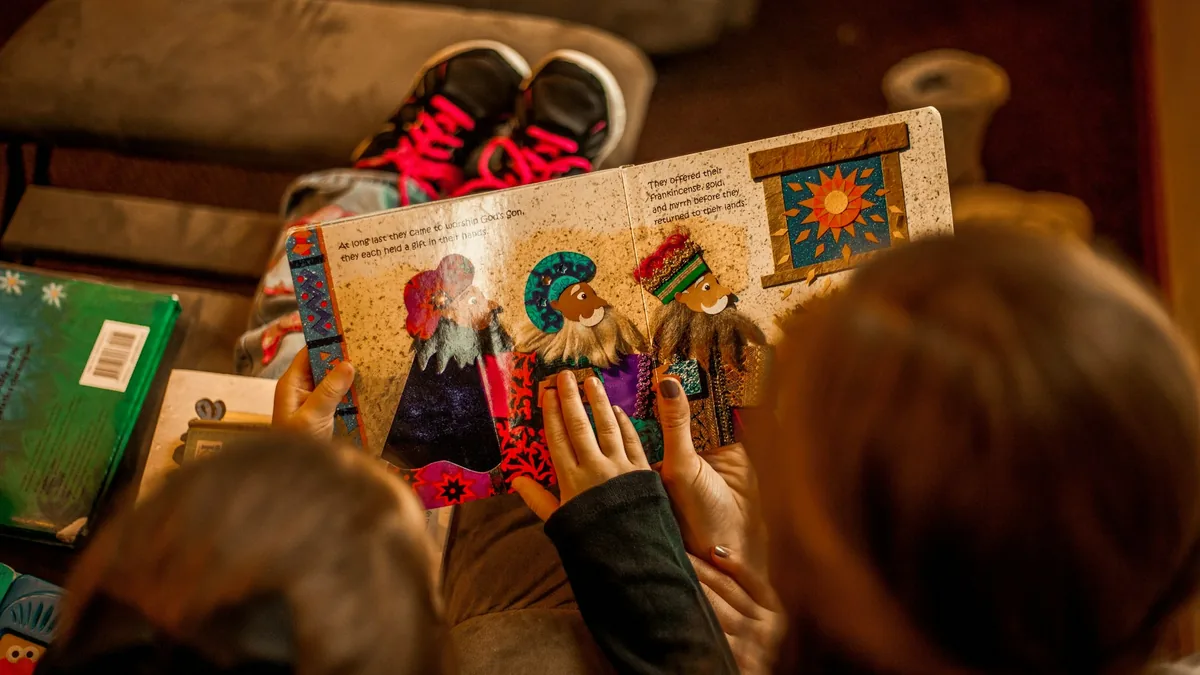
Before turning the page, ask: “What do you think happens next?” If there’s a funny picture, stop and talk about it. If your toddler wants to point at every animal and tell you its name, let them. If they know the book well enough to finish a sentence, pause and give them the chance. You’re still reading even when the conversation temporarily moves away from the exact words on the page.
Read favourites again and again.
Adults may get bored reading the same dinosaur book every night. Children usually don’t. Repeated reading gives them another opportunity to hear vocabulary, remember the story and notice details they missed before. Eventually, you may notice your child “reading” parts of the book from memory. That’s not cheating. They’re experimenting with storytelling and language.
Don’t correct every little thing.
If your preschooler is pretending to read and gets the story completely wrong, you don’t need to interrupt every sentence. Sometimes the purpose is simply to enjoy books and experiment with storytelling. Formal accuracy will matter later. Right now, you also want books to feel enjoyable. Shared books are also a calmer alternative to a screen, so it helps to know the current screen time guidelines for toddlers when you’re planning the day.
Fun Early Literacy Activities by Age
Early literacy should look different for a 1-year-old and a 4-year-old. Here’s a simple guide:
| Age | Literacy Activities to Try |
|---|---|
| 1–2 years | Board books, nursery rhymes, songs, naming pictures, pointing to objects, repeating simple words |
| 2–3 years | Rhyming songs, completing familiar book phrases, simple storytelling, noticing letters in their name |
| 3–4 years | Rhyming games, syllable clapping, alphabet play, retelling stories, drawing and pretend writing |
| 4–5 years | Letter-sound games, identifying beginning sounds, storytelling, name writing, predicting stories and more detailed conversations about books |
These aren’t milestones your child has to complete by a particular birthday. They’re simply age-appropriate ways to make literacy part of play. If your child is close to school age, it can also help to look at signs your child is ready for kindergarten alongside these activities.
Try a name hunt
A child’s own name is often an interesting place to start noticing letters. Write their name and look for the first letter elsewhere: “There’s an A on that cereal box too!”
Clap the syllables
Use familiar names and words. EL-E-PHANT. Three claps. TI-GER. Two. Then try everyone’s names.
Play silly rhyming games
Ask: “What rhymes with cat?” Your preschooler might say “hat.” They might also say “zat.” That’s okay. A made-up word can still demonstrate that they’re hearing and manipulating the rhyme.
Tell stories without a book
Give your child three toys and invent a story together. Maybe the dinosaur needs to go to the grocery store, but the teddy bear has taken the car. Ask your child: “What happens next?” Storytelling builds language without requiring printed words at all.
We currently provide daycare services in three main Calgary locations:
How Play-Based Programs Build Literacy
Literacy development doesn’t have to happen at a desk. In a play-based early learning environment, literacy can appear throughout the day. Children might create a pretend restaurant and make a menu. They might draw a picture and tell an educator what it means. They might sing songs that feature rhymes and repeated sounds. They might listen to a story as a group and talk about the characters afterward. They may see their names written on cubbies, artwork or activity areas. All of those experiences connect language, symbols, print and communication to something meaningful.
Alberta’s Flight Early Learning and Care Framework places play at the centre of early childhood learning. Play gives children opportunities to explore, communicate, imagine and make sense of their experiences rather than simply receiving information, which is exactly what play-based learning is in practice.
At Clever Daycare, early literacy activities are part of the ordinary day: children experience early literacy through stories, conversations, songs, creative activities, imaginative play and meaningful interactions throughout the day. Because expectations change as children move on, it also helps to understand the differences between preschool, pre-kindergarten and kindergarten in Alberta.
If you’re looking for a Calgary daycare where early literacy is part of everyday learning, Clever Daycare offers children opportunities to build language, communication and pre reading skills through stories, conversations, songs, creative activities and play. Explore our Clever Classes curriculum to see how learning is woven into the day, read more learning and development articles for parents, or talk with the Clever Daycare team about finding the right program for your child.
FAQ
At what age should I teach my child to read?
There’s no need to set a specific age when formal reading must begin. Before kindergarten, focus on building oral language, vocabulary, phonological awareness, alphabet knowledge, print awareness and a positive relationship with books.
Should my child be able to read before kindergarten?
Not necessarily. Children enter kindergarten with different levels of literacy. Strong pre-reading skills and comfort with books and language provide an important foundation for learning to read.
How often should I read to my toddler?
Try to make reading a regular part of everyday life. It doesn’t need to be one long session. A few enjoyable opportunities to share books throughout the day can work well, especially with toddlers who don’t sit still for long.
Does reading the same book repeatedly help?
Yes. Repeated reading gives children more opportunities to hear vocabulary, become familiar with story structure, predict what comes next and participate in telling the story.
What are the most important pre-reading skills?
Important foundations include oral language and vocabulary, alphabet knowledge, print awareness and phonological awareness, including the ability to notice rhymes, syllables and sounds in spoken words.
How can I teach my toddler letters without worksheets?
Use letters naturally. Point out the first letter of their name, play with alphabet magnets, notice letters on signs and packages, and read alphabet books together.
What if my preschooler isn’t interested in books?
Experiment with different formats and topics. Try books about something they already love, short picture books, interactive books, funny stories or nonfiction books about animals, vehicles or other interests. You can also build literacy through songs, storytelling and conversation.
Are alphabet apps necessary for early literacy?
No. Children can build early literacy through books, conversations, songs, rhymes, storytelling, drawing, writing attempts and play. An app isn’t required for a child to develop these foundational skills.
How do rhyming games help children learn to read?
Rhyming helps develop phonological awareness, the ability to recognize and work with the sounds in spoken language. This sound awareness is an important foundation for later reading.
How does daycare help with early literacy?
A quality early learning environment can provide regular opportunities for stories, conversations, songs, imaginative play, drawing, early writing and interaction with print. Group activities also give children opportunities to hear and use language with educators and other children.