There is no single approach that works best for every child. Montessori may appeal to children who enjoy predictable routines, independence and focused activities. Play-Based learning gives children opportunities to learn through movement, imagination and social interaction. Reggio Emilia emphasizes curiosity, relationships, creativity and collaborative investigation.
The best choice isn’t necessarily the philosophy that seems to match your child’s personality on paper. The quality of the educators, classroom environment and daily interactions often matters more than the label itself.
Montessori vs Play-Based vs Reggio Emilia at a Glance
| Area | Montessori | Play-Based | Reggio Emilia |
| Main focus | Independence, concentration and practical skills | Learning through play, movement and exploration | Curiosity, relationships and project-based learning |
| Daily structure | Predictable and organized | Flexible, with guided and child-led play | Flexible and shaped by children’s questions |
| Child’s role | Chooses activities from a prepared environment | Explores interests through play | Helps guide projects and investigations |
| Educator’s role | Observer and guide | Facilitator who extends learning through play | Collaborator and co-learner |
| Common activities | Practical life tasks and specialized materials | Pretend play, blocks, stories, art and outdoor play | Group projects, discussion, art and investigation |
| Independence | Strong focus | Encouraged naturally | Encouraged alongside teamwork |
| Social interaction | Mix of individual and group activities | Frequent social and imaginative play | Strong focus on collaboration |
| May suit children who | Enjoy routine and working independently | Learn through active, social experiences | Enjoy creativity, questions and group projects |
These differences are helpful, but real early learning programs do not always fit perfectly into one category. Many centres use a blended approach, borrowing useful elements from several early childhood education philosophies.
Our daycare programs include both emergency daycare in Calgary and dependable Regular Hours Daycare to support different family schedules and needs.
What Each Approach Actually Means
Montessori: Structured and Independence-Focused
Montessori education is based on the idea that children learn well when they can make choices within a carefully prepared environment.
Instead of asking the whole class to complete the same task at the same time, children usually choose from age-appropriate materials and work at their own pace. The educator observes, demonstrates activities and offers help when needed.
High-quality Montessori programs typically include trained Montessori educators, mixed-age classrooms, specialized materials, child-directed work and uninterrupted work periods.
A typical Montessori classroom may include activities such as pouring water, sorting objects, preparing food, tracing letters or working with early mathematics materials. These activities are designed to support concentration, coordination, confidence and practical independence.
Montessori may be a good fit if your child:
- Enjoys predictable routines
- Likes completing tasks independently
- Can stay focused on one activity
- Feels proud when doing things without help
This does not mean Montessori is only suitable for quiet children. A skilled educator can also help active or social children gradually build concentration and independence.
Play-Based Learning: Child-Led and Interest-Driven
In a play-based program, play is not something children do after learning. Play is one of the main ways learning happens.
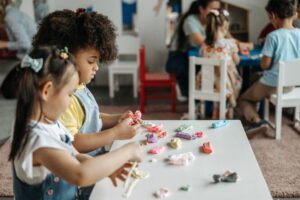
A child building a tower is exploring balance, size and problem-solving. Children pretending to run a shop may be practising language, counting, cooperation and turn-taking without feeling as though they are completing a formal lesson.
High-quality Play-Based learning is not simply “free play” all day. Educators prepare the environment, observe children’s interests and step in when a question, new material or a small challenge could deepen learning.
Guided play allows educators to work toward learning goals without taking control away from the child. The adult may ask questions or introduce materials, while the child still leads the activity.
Play supports more than creativity. The National Association for the Education of Young Children identifies play as an important part of language, self-regulation, cognitive development, social skills and learning across different subjects.
Play-Based learning may suit a child who:
- Learns best through movement and hands-on experiences
- Enjoys pretend play and storytelling
- Likes playing with other children
- Often explores by touching, building or experimenting
Parents sometimes worry that play-based programs do not prepare children for kindergarten. In reality, a strong program can support early literacy and numeracy while also helping children communicate, follow routines, manage emotions and solve everyday problems.
Reggio Emilia: Relationship, Inquiry and Project-Based
The Reggio Emilia Approach originated in the municipal preschools and infant-toddler centres of Reggio Emilia, Italy. It views children as capable, active participants in their own learning and places strong emphasis on relationships, collaboration, creativity, inquiry and documentation.
Rather than following a predetermined sequence of activities, educators observe children’s interests and questions and use them to shape ongoing investigations and projects. A small moment of curiosity can grow into a project lasting several days or weeks.
For example, if children become interested in rain, they might collect water, compare puddles, paint rainy scenes, build shelters, read stories and talk about where water goes. The same topic may include science, language, art, teamwork and problem-solving.
Reggio Emilia also places strong importance on the many ways children express ideas. This is often described as the “hundred languages of children,” referring to the many ways children can think, communicate and construct knowledge through drawing, movement, construction, music, conversation and other forms of expression.
Another important feature is documentation. Educators may record children’s comments, display photographs or show the different stages of a project. This helps families, teachers and children understand how learning developed over time.
Reggio Emilia may work well for a child who:
- Frequently asks questions
- Enjoys art and creative activities
- Likes exploring one topic in depth
- Feels motivated by group projects and discussion
Reggio-inspired programs can also work for quieter children. A child does not always need to speak in front of a group; they can share ideas through drawing, building, movement, or other forms of expression.
We provide age-based daycare services in Calgary for:
Key Differences Between Montessori, Play-Based and Reggio Emilia
How Do They Use Play?
| Approach | Role of Play |
| Montessori | Children engage with purposeful hands-on materials and practical activities. The role and amount of imaginative play can differ across Montessori environments. |
| Play-Based | Play is the main learning method. Children develop skills through pretend play, exploration, games and social interaction. |
| Reggio Emilia | Play supports investigation, creative expression and longer-term projects based on children’s interests. |
The biggest difference in Montessori vs Play-Based learning is how activities are organized. Montessori environments typically offer carefully designed materials with specific developmental purposes, while Play-Based environments often provide more open-ended materials that children can use in different ways.
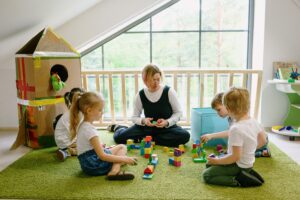
For example, a Montessori material may have a particular sequence or purpose. In a play-based classroom, the same cardboard box could become a house, car, shop or spaceship.
How Much Structure Does Each Approach Have?
| Approach | How structure is typically provided |
| Montessori | Predictable routines, prepared environment and defined materials |
| Play-Based | Educator-planned environment with flexible, child-led and guided play |
| Reggio Emilia | Flexible planning shaped by children’s interests, relationships and investigations |
Structure is not automatically good or bad. Some children feel safe when the routine is clear, while others stay more engaged when there is room to move between activities and follow their interests.
What Is the Educator’s Role?
| Approach | Educator’s Role |
| Montessori | Observes, demonstrates materials and protects the child’s concentration |
| Play-Based | Prepares activities, joins play and extends learning through questions |
| Reggio Emilia | Collaborates with children, observes emerging interests, supports investigation and documents learning |
In all three approaches, the educator should be actively involved. The difference is not whether adults teach, but how and when they guide the child.
What Type of Environment Might Your Child Enjoy?
These are tendencies, not rules. Children can thrive in different environments, and their needs may change as they grow.
Montessori may appeal to children who…
Your child may enjoy Montessori if they feel comfortable with routines and like knowing where things belong. It may also suit children who enjoy repeating an activity until they feel they have mastered it.
Children who regularly say “I can do it myself” may appreciate the strong focus on independence. They are given meaningful chances to make choices and take care of their own environment.
Play-Based learning may appeal to children who…
Play-Based learning may be a better match for children who learn through movement, conversation and imagination.
If your child turns everyday objects into pretend toys, enjoys active exploration or regularly seeks out other children, a play-based environment may feel natural and motivating.
Reggio Emilia may appeal to children who…
Reggio Emilia may appeal to children who enjoy asking “why?” and following an idea for more than a few minutes.
It can be especially engaging for children who enjoy making things, drawing, experimenting, or working with others to solve problems.
Your Child Does Not Need to Fit One Category
Children are complex and often show qualities that fit all three approaches.
An energetic child might still enjoy the calm structure of Montessori. A quiet child may slowly become involved in Reggio-style group projects. A child who likes independent activities can still benefit from social play.
It is also helpful to think about what your child needs to develop. A highly social child may need more opportunities to build concentration, while a very independent child may benefit from collaborative experiences.
What to Look for When Visiting a Program
A preschool tour can tell you much more than a centre’s website. Pay attention to how the program actually feels during a normal day.
The classroom does not need to be silent, perfectly tidy or filled with expensive materials. It should feel safe, purposeful and welcoming.
Classroom and Educator Checklist
During your visit, look for the following:
- Children appear comfortable, involved and interested
- Educators speak calmly and respectfully
- Adults respond when children need help or comfort
- Materials are safe and easy for children to access
- Children have time for active and outdoor play
- Activities match the children’s age and development
- The room feels organized without being overly restrictive
- Families receive regular updates about their child
- Educators can explain how they support individual needs
Watch how educators handle small disagreements, mistakes and strong emotions. These everyday moments often reveal more about program quality than the teaching philosophy itself.
Questions to Ask During a Preschool Tour
You may also want to ask:
- How do you decide what children will learn each week?
- What does your philosophy look like in a typical day?
- How much of the day is child-led?
- How do you support children who struggle with transitions?
- How do you prepare children for kindergarten?
- How do you communicate with parents?
- How much time do children spend outdoors?
- How do you support different personalities and learning styles?
- Are educators trained in the philosophy the centre follows?
Ask for real examples. A specific explanation of a recent activity is more useful than a general statement such as “we are child-centred.”
Our three main daycare locations in Calgary include:
Choosing the Best Early Learning Approach
There is no clear winner among Montessori, Reggio, and Play-Based learning.
Montessori offers more order, independence and purposeful materials. Play-Based learning gives children room to learn through imagination, movement and social interaction. Reggio Emilia supports deeper investigation, creativity and collaboration.
The best early learning approach is the one where your child feels secure, understood and interested in participating. A strong relationship with caring educators will often have more influence than the name of the philosophy.
Find a Play-Based Learning Environment at Clever Daycare
At Clever Daycare, we believe children learn best when they have opportunities to explore, play, ask questions, build relationships and develop independence in a supportive environment.
Our approach incorporates meaningful play, age-appropriate structure, hands-on exploration and educator-guided learning. Rather than expecting every child to learn in exactly the same way, our educators observe children’s interests and developmental needs and adapt their support accordingly.
If you’re comparing Montessori, Reggio Emilia and Play-Based preschool programs, we encourage you to look beyond the philosophy name and see how learning actually happens throughout the day. Book a tour to meet our educators, explore the environment and see how we support children’s learning through play.
FAQ
Is Montessori better than Play-Based learning?
Not necessarily. Montessori usually offers more structure and independent work, while Play-Based learning focuses more on imagination, movement and social play. The better choice depends on your child and the program’s quality.
What is the biggest difference between Montessori and Reggio Emilia?
Montessori uses a prepared environment with specialized materials and a more established learning sequence. Reggio Emilia develops learning through children’s questions, relationships and collaborative projects.
Does Play-Based learning prepare children for kindergarten?
Yes. A high-quality Play-Based program can support early language, literacy, mathematics, self-regulation, communication and social skills.
Is Montessori too strict for active children?
Not always. Montessori classrooms are organized, but children can move around, choose activities and work at their own pace. The fit depends on how the program is delivered and how the educator supports the child.
Is Reggio Emilia mainly focused on art?
No. Art is an important form of expression, but Reggio Emilia also includes science, language, problem-solving, relationships and investigation. Creative materials help children explore and communicate their ideas.
Is a Play-Based preschool just free play all day?
No. In a strong Play-Based program, educators intentionally prepare the environment, observe development and extend learning through materials, questions and guided activities.
Which approach is best for a shy child?
There is no single answer. Some shy children enjoy the predictable environment of Montessori, while others build confidence through small-group play or Reggio-style projects. Warm and patient educators are especially important.
Can a preschool combine all three approaches?
Yes. Many programs combine parts of Montessori, Play-Based and Reggio Emilia. A blended approach can work well when educators clearly understand why and how they use each element.
Which approach provides the best school readiness?
All three can prepare children for school when implemented well. School readiness includes early academic skills, as well as independence, communication, emotional regulation, curiosity, and the ability to participate in a group.
What matters most when choosing a preschool?
Look at educator-child relationships, safety, communication, daily routines, child engagement and how the centre responds to individual needs. The philosophy is important, but it should not be your only deciding factor.